Last Updated Jan.6/99
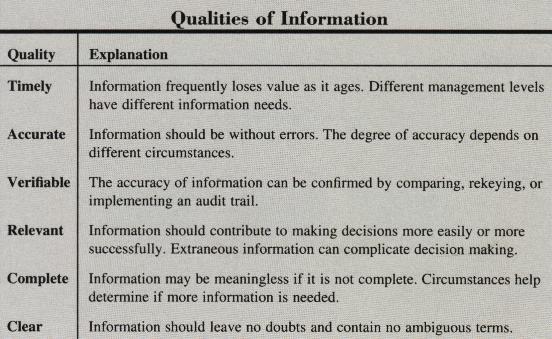
A business manager does not need outdated information, or information that is not complete. Furthermore, managers only want accurate, relevant information. The most valued information is accurate, verifiable, timely, relevant, complete, and clear.
Information should be accurate (error free). It is
difficult to provide error free information; inaccuracies can occur
when data is put into the system, or it can be
inappropriately processed. Erroneous data
entered into the computer system brings about a situation known as
"GIGO" or "garbage in-garbage out." The degree of
accuracy acceptable to most decision makers depends on the
circumstances. When decisions must be made quickly, there are
trade-offs between speed and accuracy. Information produced quickly
may not be error free.
Accurate information is verifiable. In other words, it can be confirmed. Verification can be accomplished in different ways. One approach compares the new information with other information that is accurate. Another approach involves reentering new data and comparing the processed information with the original. A third approach, an audit trail, traces the information back to its original source. An audit trail describes the path that leads to the data on which information is based. A decision maker evaluates the audit trail description to verify the accuracy of information. Any well designed information system should include a plan for an audit trail. Information that cannot be verified cannot be depended upon for decision making.
The timeliness of information is important because information frequently loses its value as it ages. Information necessary for routine business operations must be current. For example, a warehouse manager needs up-to-the-minute reports on inventory levels to fill orders promptly. A report generated last year would be useless in determining inventory levels for the current week. The type of information needed for long-term planning, however, may require more than current information. A future sales campaign may be based on sales figures that span a five-year period, revealing past sales trends. Therefore timely does not always mean current; timely information is appropriate information that is available when needed.
Even the most timely information is useless if it does not actually contribute to making a good decision. Extraneous information can complicate decision making, whereas relevant information makes it easier. Relevant information is information that a manager or a staff specialist "needs to know" in order to make a particular decision. A company comptroller performing an audit does not need the plant maintenance schedule for the past year, he needs financial records. Relevant information is new knowledge that actually assists the appropriate person in decision making.
Before making decisions, managers must determine if the information is complete or if more is needed. Accurate, verifiable, timely, relevant information is meaningless if it is incomplete. The completeness of information refers not to the quantity of information, but rather its content. Large volumes of information may be present, but one crucial detail may have been overlooked. Circumstances influence whether or not the missing information hampers decision making. At one time incomplete information may have little effect, whereas at another the missing information could have serious consequences. For example, a fire department will respond immediately to a report of a fire in a chemical plant. Once at the scene, however, firefighters may need more complete information to fight the fire effectively. The chemicals inside the building affect decisions about techniques used to combat the blaze. Without this information, firefighters could use the wrong containment techniques and actually spread the fire instead of putting it out.
Finally, information should be clear. It should contain no ambiguous terms and should be stated in a way that leaves no doubts concerning the meaning of facts. A report that contains vague generalities and ambiguous terms quickly loses its value to an organization.
All these qualities are equally important if the receiver of the information is to have complete confidence in using the information for decision making. Unfortunately, limitations in time and money may necessitate compromises in any of these areas.