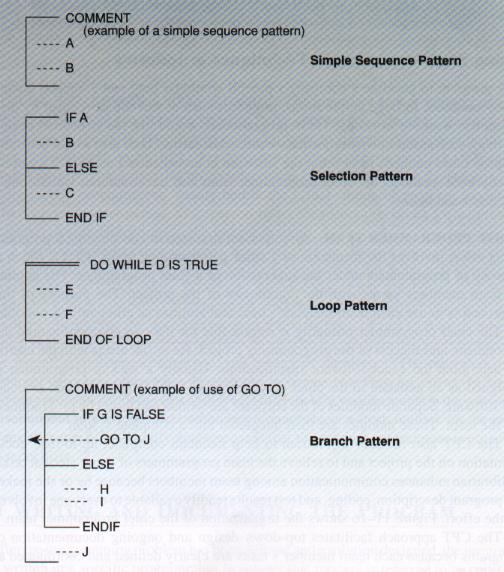
Action diagrams are an alternative form of documenting a designed solution to a problem. Action diagrams lend themselves to a top-down design because they can be used to document each level of the design. They can be used at a high level where structure charts or HIPO diagrams might be used as well as at a detailed level where pseudocode might typically be used. By using action diagrams, there can be a natural progression from a high level to a low level of detail because of the consistent method of documenting each level of the solution. This eliminates the need to mix alternate methods of documenting such as mixing structure or HIPO charts with pseudocode or flowcharts.
Action diagrams also use notation that supports structured programming techniques including modularization, functional decomposition, structured control constructs, and hierarchical organization. Action diagrams use brackets ([) as their basic building blocks. Each bracket begins with a label which describes the task done in that block, and each one except simple sequence also ends with a label to mark the end of the task. The Figure below illustrates how the four basic logic patterns would be documented using action diagrams,
Action Diagrams for the Four Basic Logic Patterns
while the next Figure shows an action diagram for the payroll processing example.
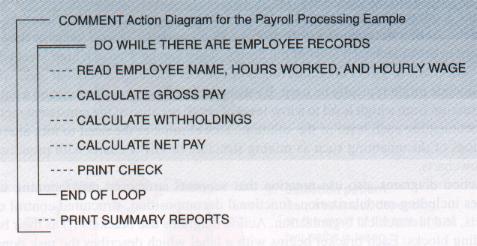
Action Diagram for the Payroll Processing Example
Note that a bracket with a double bar at the top is used to denote a loop pattern and an arrow extending out through a bracket is used to indicate a GOTO.
Last Updated Jan.7/99